
Shopping for a landing light, you’ll run into big, confident numbers: “10,000 lumens!” “200 watts!” The uncomfortable truth — neither tells you how well you’ll actually see the runway. The number that matters is candela, and it’s the one a lot of listings bury or leave off entirely.
Reading a spec sheet by the wrong number is the single most common way owners get talked into the wrong light. Here’s how to read it right.
The four numbers on the box — and what each really tells you
| Candela (what you see) Light intensity in a specific direction — how bright the beam is where you point it, down the runway. What position and landing lights are rated in, and what matters from the cockpit. | Effective candela (strobes) The FAA’s rating for flashing lights, via the Blondel-Rey formula for how the eye perceives a flash. Anti-collision lights use this — don’t compare it to a steady light’s candela. |
| Lumen (total output) Total light in all directions at once. Great for a room; misleading for a directional aircraft light, where only the light focused down the beam counts. | Watt (power drawn) A rate of energy transfer — what the light draws, not what it makes. A high-watt incandescent throws far less usable directional light than a low-watt LED. |
The key fact nobody selling a cheap light wants to explain
There is no conversion from lumens to candela. None. A light advertised only in lumens is telling you something real — it’s just not what you think it is.
From the cockpit, what you see is candela: the light projected down the runway where you need it. Lumens describe total spill in every direction — a byproduct, not the point. When a listing leads with a giant lumen number and hides the candela, that’s a marketing decision, not a performance claim. High candela is what defines approach quality.
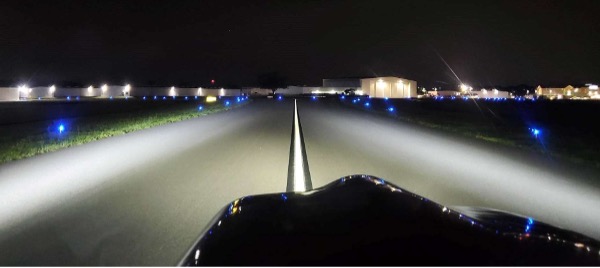
Same size, same power — wildly different jobs
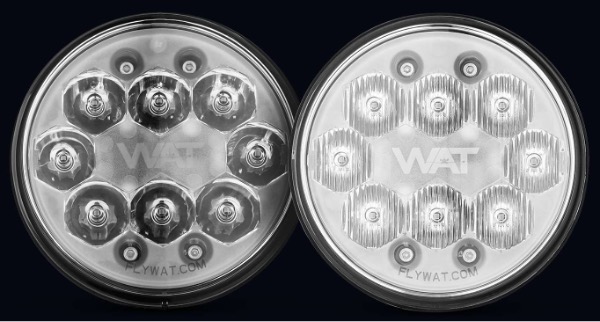
The landing light (left) uses engineered parabolic reflectors to concentrate the beam into a tight, far-throwing cone — high candela, long reach. The taxi light (right) spreads the same LED output across a wider, softer pattern for close-in ground coverage — lower candela by design, because a laser beam is the last thing you want while taxiing. Neither is “brighter.” They’re tuned for different missions — exactly what candela captures and a lumen or watt number cannot.
What “good” candela actually looks like
| Product | Candela | Beam pattern | Best for |
| Parmetheus G3 | 130,000 | 12° focused | Value + low draw |
| SunSpot 75W | 200,000+ | 15° spread | Entry pulse / night |
| SunSpot 100W | 220,000+ | 20° spread | Max performance |
| SunSpot Equinox | 210K land / 65K taxi | 20° / 50° dual | Max + dual taxi/landing |
The beam angle moves with the mission: a tighter angle concentrates candela for reach; a wider angle trades peak intensity for coverage. The Equinox does both in one lamp.
How to read a spec sheet without getting fooled
Sold only in lumens or watts? Ask for the candela. If the seller can’t produce it, that absence tells you something.
Match the beam angle to how you fly. Tight (12–15°) concentrates intensity for reach; wide (45°+) trades peak candela for spread and daytime conspicuity; a dual-beam lamp covers taxi and landing in one.
Don’t compare a strobe’s effective candela to a landing light’s candela. Different measurement, different job.
Watts describe load, not brightness. A 100W LED landing light and a 100W Incandescent landing light both draw the same 4.19 Amps. This difference dis where the incandescent loses efficiency to heat and poor design, the LED converts more energy to where you need it most. The good news is, there are offerings from both Whelen Aerospace Technologies and AeroLEDs that reduce electrical load while offering a premium upgrade over incandescent. This means more usable light, less alternator load.
Not sure which candela and beam fit your airplane?
Tell us your aircraft and how you fly it — busy towered fields, rural strips at night, backcountry, wildlife country — and we’ll match you to the right intensity and beam pattern instead of the biggest number on a box. It’s a free, no-obligation conversation.
Schedule your free lighting consultation →
Prefer to look first? Browse certified LED lighting.
Photos courtesy of Aero-Mach Wilco / Whelen Aerospace Technologies / AeroLEDs. Candela figures are representative; confirm current specifications before ordering.