
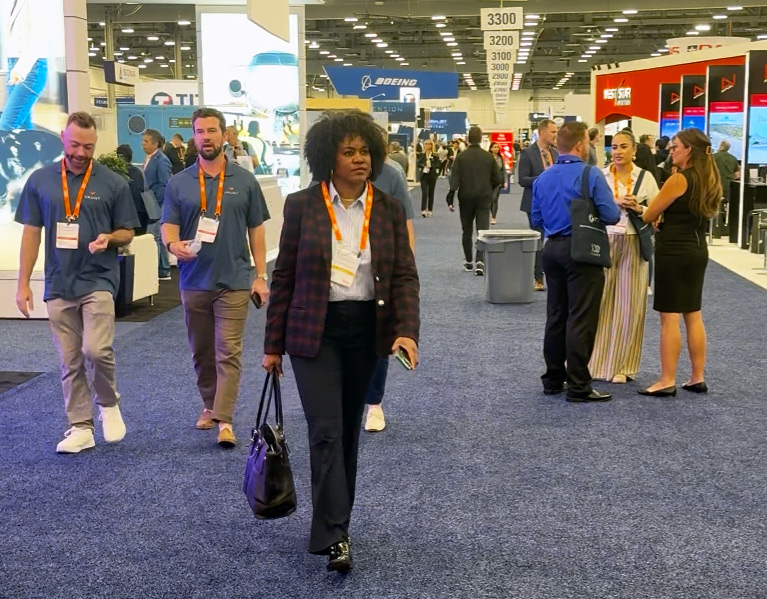
NBAA brings together nearly every corner of business aviation, but some of the most valuable conversations rarely begin with a product.
They begin with a problem.
- “I need this part, and I don’t have time to find it.”
- “This program still matters, but it is consuming resources we need somewhere else.”
- “We know we need static dischargers on this composite aircraft, but bonding them effectively presents a challenge.”
Those are the conversations we are looking forward to having at NBAA 2026.
Aero-Mach operates across several areas of aviation, and while our businesses may look different from one another, there is a common thread running through much of what we do: we take on difficult, specialized problems so our customers can concentrate their resources on what they do best.
Here are four of those challenges.
1. “I Need It, and I Don’t Have Time to Find It.”
There are times when the biggest cost associated with an aircraft part isn’t the price of the part. It is the time required to find it.
One of our aircraft OEM customers has helped us develop a business model around a very simple need:
“I need it, and I don’t have time to find it.”
We call it On-Demand sourcing.
Instead of assigning someone inside their organization to spend hours searching suppliers, tracking down obscure parts, evaluating possible alternatives and making phone calls, they send the problem to Aero-Mach Wilco.
Then we go to work.
The cornerstone of that relationship is not simply our ability to locate a part. It is trust.
Our customer trusts us to search the marketplace, identify a legitimate solution and provide it at a fair and reasonable price. Urgency doesn’t become an excuse to take advantage of the situation.
That trust has allowed the relationship to evolve beyond a traditional buyer-and-seller transaction. In effect, part of the sourcing responsibility has been delegated to us.
That is a niche within Aero-Mach Wilco that we have never aggressively marketed, but it is one we believe could provide significant value to other aircraft manufacturers and aviation organizations.
If your purchasing or support team regularly encounters requests where the real issue is, “Someone needs to find this, and we don’t have time to do it,” that is a conversation we would like to have.
2. When the Requirement Doesn’t Fit the Catalog
Not every procurement problem starts with a part number.
Sometimes the problem is a material, size, specification or quantity that doesn’t fit neatly into the traditional distribution model.
That might mean locating an unusual aircraft component. It might mean sourcing material for a manufacturing or repair requirement. It might involve 4130 steel in a particular thickness or configuration that isn’t readily available through the normal channels.
The common problem is the same: what the customer needs exists, but obtaining it isn’t straightforward.
This is an area where the sourcing capabilities within Aero-Mach Wilco continue to expand.
We believe a good distributor should be able to provide more than a searchable catalog. When standard procurement stops working, there should still be someone willing to pick up the phone, understand the requirement and start looking for a solution.
Sometimes that means supplying something already sitting on our shelf. Sometimes it means finding something that isn’t.
For the customer, the important part is that the problem gets solved.
3. “This Program Still Matters. It Just Shouldn’t Require This Much of Our Organization.”
Somewhere inside many established aerospace companies is a mature product or legacy program that still has customers, still generates revenue and still needs support.
The problem is that maintaining it requires engineering time, production capacity, supply-chain resources, customer support and management attention that the organization increasingly needs elsewhere.
These programs can become difficult decisions.
They aren’t unsuccessful products.
Quite often, the opposite is true. Customers still depend on them.
But the organization that originally developed the program may now be focused on newer aircraft, new technology, production expansion or other priorities. A relatively small legacy program can begin consuming resources that are increasingly valuable to the rest of the company.
Aero-Mach Labs provides another option: move the program to a contract manufacturing partner capable of supporting it for the long term.
The objective isn’t to make the legacy program go away.
It is to make the burden of supporting it go away.
We have completed this type of transition with major aviation companies under agreements that prevent us from publicly identifying many of the programs involved.
What those experiences have demonstrated is that many of the fears surrounding a transition can be addressed with the right structure.
- The product can remain available.
- Customers can continue receiving support.
- Revenue associated with the program can be preserved.
- Engineering knowledge and production capability can be transferred rather than lost.
And in situations where employees are closely tied to the program, the transition may create an opportunity for those employees to continue supporting the product within our organization while allowing the OEM to redirect its internal resources toward higher-priority programs.
For many companies, the hardest part isn’t determining whether a mature program belongs with a specialized manufacturing partner.
It is making the decision to move it.
If your organization has a program that remains important to your customers but has become increasingly difficult to justify internally, that is a conversation we would especially like to have at NBAA.
4. Solving the Static-Discharge Challenge on Composite Aircraft
Composite aircraft construction provides tremendous advantages, but it also changes the way engineers have to think about electrical conductivity and precipitation static.
On a conventional metal airframe, the aircraft structure itself provides a conductive path that can be incorporated into the static-discharge system.
Composite structures present a different challenge.
Depending upon the materials and construction methods involved, electrical conductivity across the airframe may be considerably different from that of a traditional aluminum aircraft. Providing an effective path for accumulated static charge to reach a static discharger can therefore require additional engineering consideration.
That becomes particularly important at the point where the static discharger is attached to the aircraft.
A static wick is only useful if the electrical charge can reach it.
For composite aircraft manufacturers, creating a reliable bonding path between the aircraft structure and the discharger can be one of the more challenging parts of the installation.
That is an area where TCO Manufacturing has developed solutions specifically around the requirements of aircraft static-discharge systems.
The conversation isn’t simply about selecting a static wick.
It is about looking at the aircraft as a system: how static charge develops, how it moves across the structure, how the discharger is bonded to that structure and how the entire installation performs in service.
As composite construction becomes increasingly common across general, business and advanced-air-mobility aircraft, we believe those conversations will become even more important.
The Conversations We’re Coming to NBAA to Have
Trade shows naturally create opportunities to see new products, meet suppliers and reconnect with customers.
But some of the best conversations start with something much simpler:
“We have a problem.”
- Maybe your purchasing department is spending too much time chasing difficult parts.
- Maybe your requirement doesn’t fit neatly inside a supplier’s catalog.
- Maybe an established product line is consuming engineering and production resources that your organization desperately needs elsewhere.
- Or maybe you’re working through the unique electrical and static-discharge challenges associated with a composite aircraft.
Those are the conversations we want to have.
Because across Aero-Mach Wilco, Aero-Mach Labs and TCO Manufacturing, much of our business has been built around a simple idea:
Give us the difficult part. Then let your organization get back to doing what it does best.