
A pilot enters light snow and hears a faint hiss begin to build in the headset. Minutes later, the noise is competing with incoming radio calls—even though the radios and electrical system appeared to be working normally before the flight.
The source may not be inside the instrument panel. It may be static electricity accumulating on the aircraft and discharging from the airframe.
That is the problem an aircraft static wick, also called a static discharger, is designed to address. These small components create preferred locations where electrical charge can leave the aircraft with less intensity and less potential for radio-frequency interference.
Understanding how a static wick works also explains why aircraft normally have several of them, why many general aviation wicks have deliberately frayed ends, and why the dischargers installed on high-speed aircraft may look very different from those found on slower airplanes.
What Is an Aircraft Static Wick?
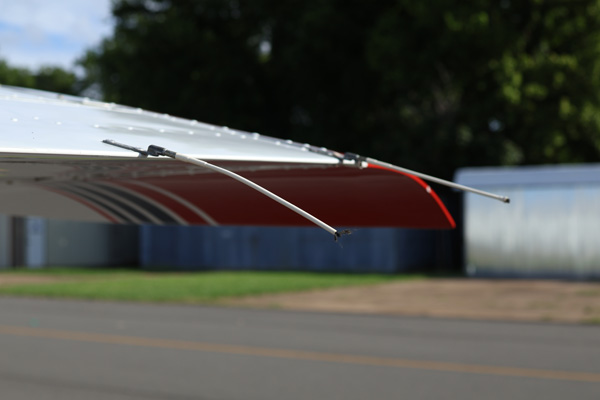
A static wick is an electrically conductive aircraft component normally installed near the trailing edges of the wings and tail surfaces. It is also commonly called a static discharger.
Multiple static wicks work together as part of the aircraft’s static discharging system. Their purpose is not to prevent static electricity from developing, and they do not ground the aircraft in flight. Instead, they provide controlled locations through which accumulated electrical charge can dissipate into the surrounding atmosphere.
This controlled discharge reduces the likelihood that electricity will leave through uncontrolled locations such as wing tips, antennas, fasteners, hinges, or sharp edges.
That matters because an uncontrolled electrical discharge can produce radio-frequency energy. Aircraft antennas may receive that energy as interference, potentially creating static, hissing, popping, weak reception, or degraded communication and navigation performance.
The FAA explains that static dischargers provide easier paths for electrical charge to leave the aircraft rather than allowing a larger charge to build and discharge from the airframe’s trailing edges—and it emphasizes that an effective system requires the proper number of dischargers installed on a properly bonded aircraft. 1
How Does Static Electricity Build Up on an Aircraft?
An aircraft moving through the atmosphere continually collides with airborne particles: rain, snow, fog droplets, sleet, hail, ice crystals, dust, volcanic ash, and other suspended material.
These interactions cause electrical charge separation between the particles and the aircraft surface. The resulting buildup is commonly called precipitation static, or P-static, in the FAA’s description, the charging of an aircraft as it encounters solid or liquid particles in flight. In a relatively short period, a substantial electrical charge can develop on the aircraft skin. 1
The faster the aircraft moves, the more air—and potentially the more particles—it encounters during a given period. Airspeed therefore influences both the rate at which charge may accumulate and the aerodynamic forces acting on the components intended to release it.
Eventually, the electrical potential between the aircraft and the surrounding atmosphere becomes high enough that charge begins to leave the aircraft. How that charge leaves is where static wicks become important.
The Moment of Discharge: Understanding the Corona Effect
Normally, air is a relatively poor electrical conductor. When the electrical field around part of an aircraft becomes sufficiently strong, however, nearby air can become ionized.
Once ionization occurs, electrical charge can begin flowing away from the airframe. This process is called corona discharge, sometimes described as the corona effect. It tends to begin around sharp points, narrow edges, and areas with a small radius—an antenna tip, wing tip, rivet, control-surface edge, or another protruding part of the aircraft—because electrical charge becomes concentrated at those locations.
This is the moment the FAA guidance cited above describes as corona: accumulated static electricity discharging from aircraft extremities, with electrical activity that can be heard in the pilot’s headset and may disrupt communication or navigation equipment. 1
A corona discharge is not necessarily one dramatic spark. It may be a continuing or repeated release of electrical energy. The critical issue is not merely that discharge occurs, it is the intensity and location of that discharge. A strong corona discharge from one uncontrolled point can produce more concentrated radio-frequency energy than several smaller discharges distributed among properly positioned static wicks.
In practical terms: the greater the intensity of the corona effect, the greater the opportunity for interference. The static discharging system is designed to reduce that intensity.
Why Aircraft Have Multiple Static Dischargers
One static wick cannot necessarily carry away all the electrical current accumulating across an aircraft. Aircraft therefore normally use multiple static dischargers positioned around the trailing portions of the wings and tail—the locations where electrical charge tends to accumulate.
Instead of allowing the airframe potential to rise until electricity escapes from one or two uncontrolled locations, multiple wicks provide several preferred discharge paths.
Think of pressure building inside a tank. If all of that pressure must escape through one small opening, the flow through that opening will be intense. Add several properly positioned outlets and the pressure can be distributed among them. A static discharging system operates on a similar principle.
With several properly functioning static wicks:
- More controlled discharge points are available.
- Each wick carries a portion of the total current.
- Less energy must leave through any one location.
- The intensity of individual corona discharges is reduced.
- Charge is released from selected areas away from sensitive antenna fields.
- The potential for radio-frequency interference is reduced.
FAA guidance explains that effective dischargers use groups of very small corona points, allowing current to begin flowing at a lower aircraft potential while minimizing the radio-frequency energy that accompanies corona discharge. 1
Static wicks do not eliminate corona discharge. They control where it occurs and divide it among enough lower-intensity locations to reduce its disruptive effects. That is why a missing static discharger can matter even when several others remain installed.
Why Some Static Wicks Have a Frayed End
Many flexible static wicks used on general aviation aircraft have a protective outer coating surrounding conductive material. At the trailing end, a small bundle of conductive fibers is deliberately left exposed. Those fibers often look slightly frayed or brush-like.
That appearance is intentional.
Each fine fiber creates a very small discharge point. Instead of the wick presenting only one relatively large point from which electricity can leave, the exposed fibers create numerous microscopic corona points. This divides the discharge even further—the same principle the FAA describes when it notes that dischargers may use fine metallic points, carbon-coated rods, or carbon wicks to permit charge to leave at lower electrical potential with less avionics interference. 1
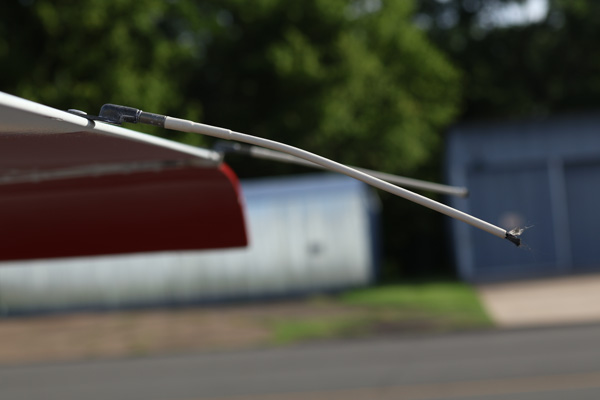
If the conductive fibers wear away, the wick loses many of those fine discharge points. The remaining end may become smoother or more blunt and may not dissipate charge with the same effectiveness. A frayed end on this type of flexible static wick is therefore not necessarily damage. It is a functional part of the design.
Not every static discharger should have exposed fibers, however. Rigid and integrated designs may use a different style of discharge tip. The correct appearance depends on the specific component.
For a detailed explanation of what normal wear looks like and how to identify damaged fibers, coating erosion, loose bases, and other replacement indicators, read: How to Inspect an Aircraft Static Wick: Wear, Damage, and Replacement Signs.
How Airspeed Influences Static Wick Design
Airspeed affects a static discharging system in two related ways. First, faster aircraft move through a greater volume of air during a given period—in precipitation, dust, or ice crystals, that can increase the rate of particle interaction and charge accumulation. Second, airspeed increases aerodynamic loading on anything projecting from the airframe.
A flexible static wick that performs effectively on a slower piston aircraft may deflect, trail, vibrate, or oscillate excessively at turbine-aircraft or business-jet speeds. If the wick moves too far from its intended position, its discharge point may no longer remain where the aircraft designer intended.
Higher-speed aircraft therefore commonly require more rigid dischargers. A rigid design can maintain a predictable position, preserve its intended separation from the airframe, resist excessive movement, and hold the discharge tip in a consistent location. Lower-speed aircraft can often use more flexible designs because the aerodynamic loads are less severe.
Neither type is universally better. The correct wick must satisfy the electrical and mechanical requirements of its particular aircraft—aerodynamic design is itself part of reducing the corona threshold and controlling the release of static charge, a point the FAA makes explicitly. 1
Static wicks may differ in:
- Electrical resistance
- Length
- Conductive material
- Tip configuration
- Rigidity or flexibility
- Mounting arrangement
- Airspeed capability
- Altitude capability
- Environmental durability
- Approved aircraft application
Physical fit alone does not establish that a replacement wick is correct.
Why Some Older Aircraft Left the Factory Without Static Wicks
Some aircraft models still in production today were originally delivered without static dischargers. That is not an oversight. Early examples often carried minimal avionics—a single radio, or none at all—and precipitation static posed little practical consequence for the way those aircraft were equipped and flown.
As panels evolved and aircraft became dependent on continuous communication, GPS, and navigation reception, manufacturers added static discharging systems to later production. The result is that two aircraft sharing the same model name may have legitimately different factory configurations, each correct for its serial number and era.
For owners of early aircraft, dischargers can often be added—but the installation must follow the airframe manufacturer’s service information and applicable regulatory requirements, and its effectiveness depends on the complete system: the proper number of dischargers, correct placement, and adequate bonding, not simply the presence of wicks. Appropriately authorized maintenance personnel should determine what is acceptable for a specific aircraft.
Why Electrical Bonding Is Part of the System
A static wick can only discharge electrical charge that can reach it.
Although an airplane may appear to be one continuous structure, it is assembled from separate wings, control surfaces, panels, hinges, fairings, fasteners, and structural sections. Physical contact between components does not always guarantee a reliable electrical path. Electrical bonding helps connect those components so charge can travel through the airframe toward the intended discharge locations.
Bonding straps are especially important across movable surfaces such as ailerons, elevators, and rudders. A control surface may have a serviceable static discharger, but the wick cannot perform properly if charge cannot reach it because of a broken strap, corrosion, contamination, or poor electrical contact.
FAA guidance states that precipitation-static discharges can occur between metallic parts that are not properly bonded, and that static dischargers should have a low-resistance bond to the airframe while maintaining the resistance required between the tip and base. 2
This is why replacing a worn wick does not solve every P-static problem. Persistent interference may also involve bonding, antennas, shielding, wiring, or the mounting interface.
Static Wicks Do Not Protect an Aircraft From Lightning
A common misunderstanding is that static wicks protect an aircraft from lightning strikes. They do not.
A static discharger manages the gradual accumulation and release of static electricity associated with flight through precipitation and airborne particles. Lightning is a much larger and fundamentally different electrical event.
Static wicks also do not carry electricity to an earth ground while the airplane is flying. Instead, they help the airframe equalize its electrical potential with the surrounding atmosphere through controlled corona discharge. Their primary purpose is to reduce precipitation-static interference and support dependable operation of communication and navigation equipment.
Protecting Static Wicks While the Aircraft Is on the Ground
Because static wicks project from trailing edges at roughly eye level, they are easily damaged—and easily walked into—during ground handling. The yellow Aero-Mach Wilco Wick Watch static wick protector addresses both problems during ground operations, and it must always be removed before flight. 3
The companion inspection article covers ground-handling damage, the Wick Watch, and preflight practices in detail: How to Inspect an Aircraft Static Wick.
Aero-Mach TCO: Static Dischargers for Aircraft Manufacturers
Aero-Mach TCO manufactures electrostatic dischargers for aircraft manufacturers and supports both current-production and legacy general aviation platforms.
Different aircraft may require flexible wicks, rigid dischargers, replaceable wick-and-base combinations, or integrated designs. The correct configuration must account for airspeed, altitude, aerodynamic loading, electrical resistance, discharge capacity, bonding, antenna placement, and the aircraft manufacturer’s installation requirements.
Aero-Mach TCO has manufactured electrostatic dischargers since 1973 and supplies products used by general aviation manufacturers, operators, and aviation suppliers. 4
Aero-Mach Wilco: Replacement Static Wicks for the Aftermarket
Aero-Mach Wilco provides replacement static wicks, bases, integrated dischargers, and related products to aircraft owners, maintenance shops, fleets, and other aftermarket customers.
Replacement TCO products are available through the Aero-Mach Wilco Static Wick catalog, which includes multiple wick, base, and integrated-discharge configurations for supported applications. 5
When identifying a replacement, the existing part number is normally the best starting point. Aircraft make and model, installation location, base style, photographs, and aircraft documentation may also be required. Two static wicks that look alike may differ in resistance, length, discharge characteristics, airspeed limits, or intended aircraft application.
Small Wicks, Lower-Intensity Discharges
A static wick performs a job that is easy to miss because the best outcome is often that the pilot notices nothing at all.
As an aircraft travels through precipitation or airborne particles, static electricity can accumulate across the airframe. When the electrical field becomes strong enough, the surrounding air ionizes and charge begins leaving through corona discharge. Without an effective static discharging system, that discharge may occur at a small number of sharp or uncontrolled locations—and the resulting corona effect can be intense enough to generate radio-frequency interference.
Multiple static wicks divide that current among many preferred locations. Flexible general aviation wicks may divide it further through a brush-like bundle of exposed conductive fibers, while rigid dischargers help higher-speed aircraft maintain a stable discharge point under greater aerodynamic loads. The result is not the elimination of static electricity. It is a lower-intensity and better-controlled release.
Frequently Asked Questions
Do static wicks protect an aircraft from lightning?
No. Static wicks manage the gradual buildup and release of precipitation static—the charge an aircraft accumulates flying through rain, snow, and particles. Lightning is a far larger and fundamentally different electrical event that static dischargers are not designed to handle.
How many static wicks does an aircraft need?
It varies by aircraft. FAA guidance requires enough dischargers to carry the accumulated current and keep airframe potential below the corona threshold of uncontrolled trailing edges. The required number and locations are specified in the aircraft’s documentation—not by comparison with other airplanes. 1
Do static wicks ground the aircraft in flight?
No. There is no earth ground available in flight. Static wicks instead help the airframe equalize its electrical potential with the surrounding atmosphere through controlled, low-intensity corona discharge at designed locations away from antennas.
Why do static wicks have frayed ends?
On many flexible general aviation wicks, the frayed appearance is intentional. Each exposed conductive fiber acts as a tiny individual discharge point, dividing the corona discharge among many microscopic locations and reducing its intensity—and the radio interference it can generate.
What causes radio static when flying through rain or snow?
Often precipitation static (P-static): charge builds on the airframe as it collides with particles, then discharges as corona from aircraft extremities. That discharge produces radio-frequency energy that antennas pick up as hissing, popping, or weak reception.
That explains how static wicks work—but it raises the practical question every pilot, owner, and technician eventually faces: how can you tell whether the wicks on an aircraft are still capable of doing their job?
Continue with How to Inspect an Aircraft Static Wick: Wear, Damage, and Replacement Signs to learn why a smooth-looking wick may actually be worn out, how to recognize coating damage, and what a loose or missing static discharger may reveal about the larger system.
References
- FAA Aeronautical Information Manual, Chapter 7, Section 6 — Safety of Flight
- FAA Advisory Circular AC 43-206 CHG 1
- Aero-Mach Wilco Wick Watch Static Wick Protector
- Industry Leading Electrostatic Dischargers | Aero-Mach TCO
- TCO Static Wicks | Aero-Mach Wilco
Technically reviewed by Aero-Mach TCO engineering staff.